Project report · 2026
Has Your Company Gone Quiet, or Just Given Up?
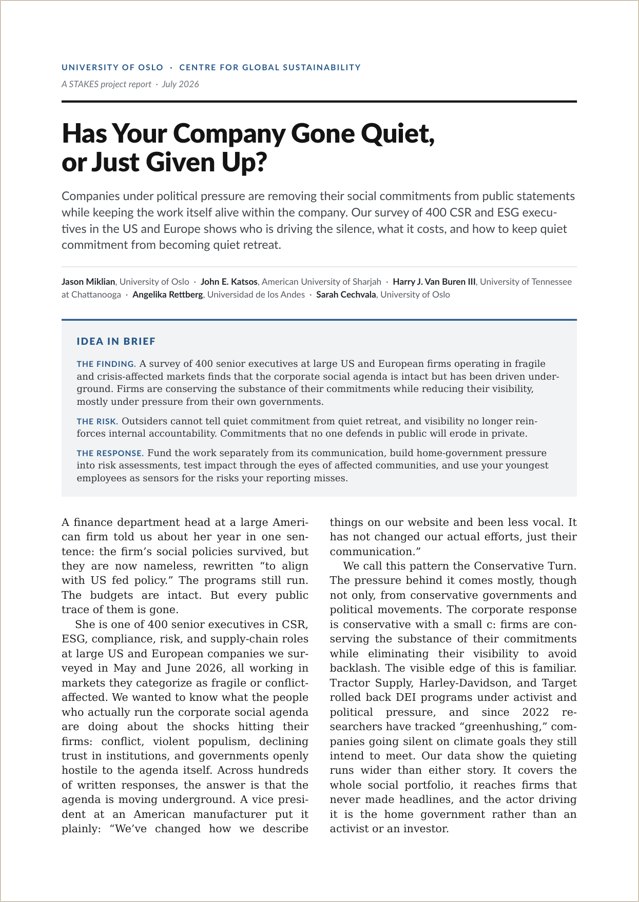
Under massive political and geopolitical pressures, companies are quietly stripping the visibility from their social activities. A survey of 400 CSR and ESG executives in both Europe and the USA shows why this silence matters, and what it costs companies now and in the future.
- Type
- Project report
- Published
- July 2026
- Publisher
- Centre for Global Sustainability, University of Oslo
- Authors
- Jason Miklian, John E. Katsos, Harry J. Van Buren III, Angelika Rettberg, Sarah Cechvala
- Research questions
- RQ1, RQ3, RQ5
- Licence
- CC BY 4.0
Abstract
What do the people who run CSR, ESG, compliance, and supply-chain divisions make of the rapid proliferation of political and operational shocks hitting their firms – including conflict, violent populism, reactionary attitudes, and declining trust in institutions – and what are they doing about it? To find out, we asked 400 social impact executives working for large US and European companies operating in fragile and crisis-affected markets.
We found that increasing parts of the corporate social responsibility agenda are moving underground. Firms disagree with and even fear their home governments more than activists or investors, yet align with them anyway. We call this new pattern the Conservative Turn. The pressure behind it comes mostly, though not only, from conservative governments and political movements. The corporate response is conservative with a small c: in many cases firms are conserving the substance of their commitments while eliminating their visibility in order to avoid public and government backlash.
The big question now: will this quieting eventually lead to a retreat on social activities? In the same way that talk can lead to action, a lack of talk can lead to a lack of action.
Key messages
- The finding. A survey of 400 senior executives at large US and European firms operating in high-risk and crisis-affected markets finds the corporate social and environmental agenda intact, but driven underground. Firms are conserving the substance of their commitments while spending down their visibility, mostly under pressure from their own governments.
- The risk. Going quiet may be strategic but it carries long-term costs. Stakeholders cannot distinguish between quiet commitment and quiet retreat, while public visibility no longer reinforces internal accountability. Over time, this low-visibility environment can encourage commitments to gradually and quietly erode.
- The response. Managers should preserve social substance even when its visibility declines, but also build organizational capabilities for incorporating home-government pressures into risk assessments, capture and scale crisis management know-how, and bring younger employees into frontline decision-making as sensors for emerging social and political risks.
What the numbers show
- Figure 1. Going quiet: how firms changed their social responsibility communications, US versus Europe.
- Figure 2. US and European executives hold the same beliefs; only the political climate differs.
- Figure 3. Where executives say the pressure is coming from.
- Figure 4. What executives will and will not concede.
- Figure 5. The environmental tilt in admitted harm and in social programs.
- Figure 6. Conceding harm, by age band.
- Figure 7. Experience, not the war itself: how much firms changed, veterans versus newcomers.
- Figure 8. Industry as exposure: which sectors feel the risks.
Method
The survey was fielded by NewtonX from 6 May to 2 June 2026 among 400 senior professionals in CSR/ESG, compliance, legal, risk, and supply-chain functions at companies with 1,000 or more employees, headquartered in the United States (201) and Western Europe (199), all engaged with social or ethical issues in operations they class as fragile, insecure, or conflict-affected. Twenty-six Likert items; free-text of roughly 2,800 responses. Quotations are verbatim.
Full text
Download the report
9 pp · CC BY 4.0
Read the full text on this site
All eight figures, the data behind each one, and the key numbers.
Concepts introduced here
Three ideas this brief put a name to, each with its own page.
- The Conservative Turn. The Conservative Turn is a pattern in which firms conserve the substance of their social and environmental commitments while spending down their public visibility, under pressure that comes mostly from conservative governments and political movements.
- Corporate quieting. Corporate quieting is the deliberate reduction of public communication about a firm's social and environmental work while the work itself continues, usually to avoid political or government attention.
- Home-government pressure. Home-government pressure is pressure on a company's social and environmental commitments that originates with the government of the country where the company is headquartered, rather than with host governments, investors or campaigners.
Topics
Cite this
Jason Miklian, John E. Katsos, Harry J. Van Buren III, Angelika Rettberg, Sarah Cechvala (2026). Has Your Company Gone Quiet, or Just Given Up?. STAKES project report. Centre for Global Sustainability, University of Oslo.
BibTeX
@techreport{miklian2026has,
  author  = {Jason Miklian and John E. Katsos and Harry J. Van Buren III and Angelika Rettberg and Sarah Cechvala},
  title   = {Has Your Company Gone Quiet, or Just Given Up?},
  year    = {2026},
  institution = {Centre for Global Sustainability, University of Oslo},
  url     = {https://stakesproject.org/outputs/has-your-company-gone-quiet/}
}